Showing posts with label underbounded. Show all posts

Monday, 14 September 2015

The Shapes of Cities

For a long time, I've been interested in the shape of cities and I suspect that if you're reading this you might be similarly afflicted. By 'shape' I mean their political boundaries as opposed to their general urban footprint. The latter can be seen by driving around or from a plane window, particularly when it's dark, but the political boundaries are much less obvious. This is particularly true of US cities. Take Houston, Texas - the first example below. 
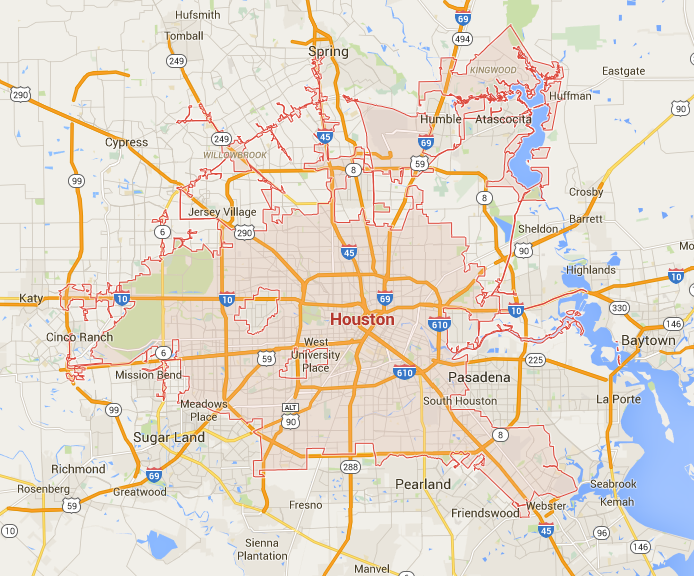
The boundary of the City of Houston - Google Map

Look closely at this and - at least if you're not used to the political geography of American cities - you might be very confused by this fragmented, segmented mess of boundaries. Then go to Google maps and try different search terms, such as 'city of los angeles' or 'city of columbus' (Ohio) and you'll soon discover that Houston isn't that unusual at all. Try it for other cities and you'll see what I mean. Columbus, Ohio is a particular favourite of mine as I know it quite well having lived there for a couple of years in the early 2000s.

City of Los Angeles - Google Map

City of Columbus (Ohio) - Google Map

These unnatural-looking boundaries are the result of a complex mix of geography, history and politics that have real impacts on the ground. From education and transport to housing and waste management, the shapes of cities really do matter in this respect. Of course, this is a much-studied topic in urban studies, not least by Professor John Parr of the University of Glasgow. In Parr's economic definitions of the city, he outlines four types - but none of these explain the kinds of boundaries we see above. One major explanatory factor in all of this, of course, is tax revenue. But I'm not going to get into that now because it opens up a whole range of other topics, including white flight, suburbanisation, and schooling, amongst other things. The point is that the 'shapes' of cities are not accidental and who is included or excluded is inherently political. 

In the United Kingdom, we might not have such unusual city boundaries, but the political geography of our cities is far from perfect - perhaps one reason for the resurgence of the 'city-region' concept over the past decade or so. When we're talking about urban economies, it makes much more sense to think about the functional urban area than it does to use data associated with an arbitrary political shape. This is as true in the US as it is in the UK. The example below shows that the City of Atlanta has less people than the City of Liverpool and that it's only slightly bigger in scale. But anyone who knows anything about these places will understand that 'Atlanta' is much bigger than 'Liverpool and is vastly more sprawling, with a metropolitan population of around 5.5 million compared to less than a million in 'Liverpool' (by one definition). 

Atlanta vs Liverpool - which is bigger?

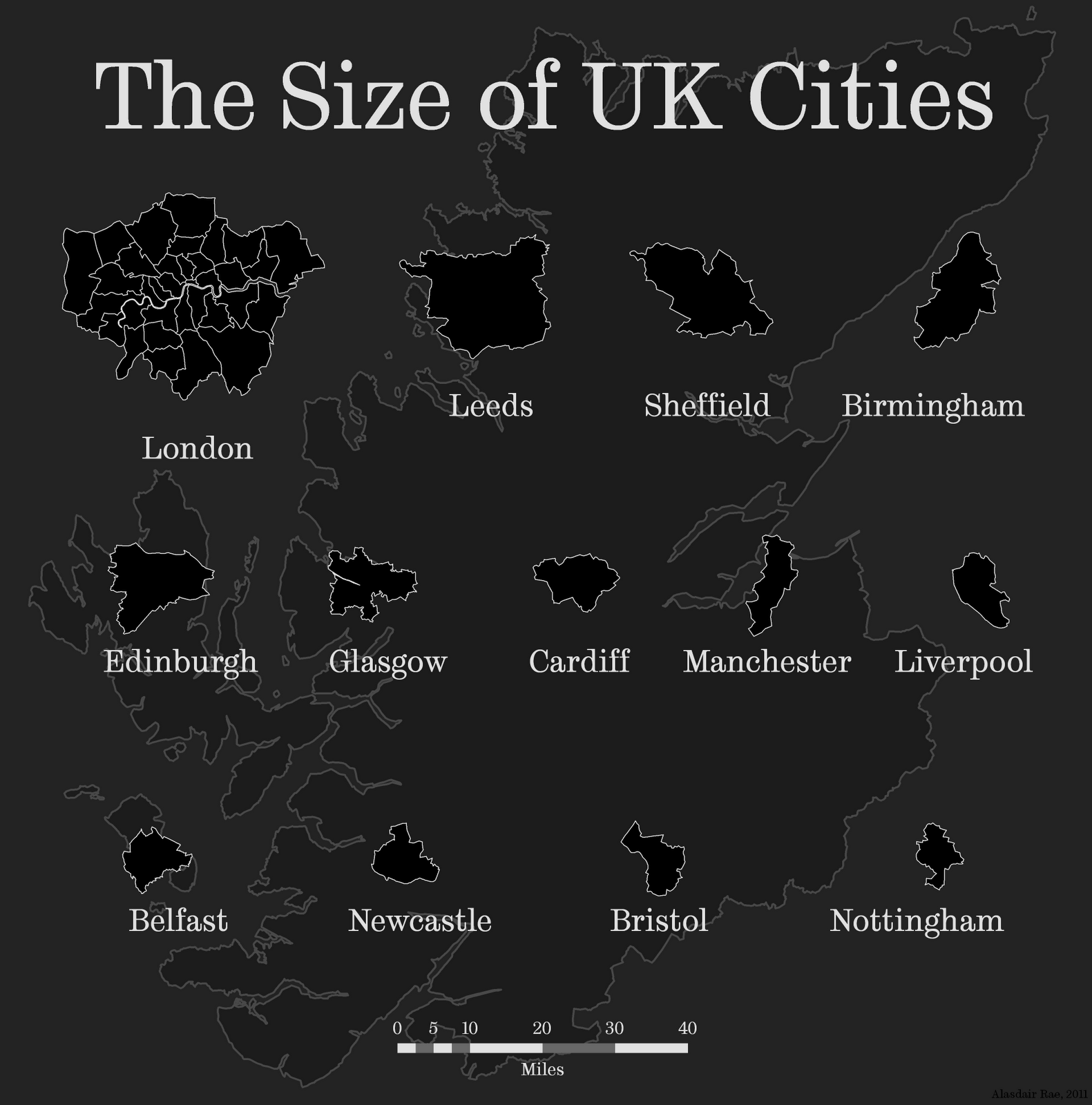
These kinds of issues are part of the reason organisations like the Centre for Cities use the Primary Urban Area definition of cities for the 64 largest urban areas of the UK. In a recent study, I used a definition developed by Geolytix which is based on the 'sprawl' of the urban area rather than political boundary and found this to be a much better fit than the administrative area. When conducting comparative analyses of cities, we need to ensure we are comparing like with like, and using a functional definition often helps avoid the kinds of underbounded/overbounded problems that arise when (e.g.) comparing places like Manchester and Leeds. The former is normally said to be 'underbounded' because the functional urban area is much bigger than the local authority area of the same name and the latter is said to be 'overbounded' because of its much wider local authority area, which extends beyond the core urban fabric. For a comparison of UK 'city' sizes, see this graphic I produced a few years ago:

All cities shown at the same scale
Surely there's a point to all of this? 

Yes, glad you asked...

For planners, politicians, residents and neighbours, the shapes of cities matter enormously. It might dictate which school your children can go to, whether your local facilities are well funded, whether you have a well-functioning local transport system, when your bins get emptied, how many pot-holes you have in your street and all sorts of other things. But let's not get into that now. Instead, I'll end with another city shape, this time for the City of Detroit (one of my favourite cities, but much-maligned).

Detroit - 8 mile boundary line to the north


Tuesday, 4 November 2014

Manchester: a "Northern Powerhouse"

The announcement yesterday from the Chancellor that we need a "Northern Powerhouse" in England was greeted with much enthusiasm - and also a good bit of cynicism, given that it's not far from the General Election. After the announcement, the BBC asked whether more English cities should be like Manchester. What I wanted to know was how this nascent northern powerhouse compared to the already established southern one (London, I think). We all know the numbers - well most do - but what about spatial scale, density and visual comparisons? Given a previous bit of mapping on the urban fabric of England and the fact that I've been thinking about the 'underbounded' nature of the City of Manchester (as opposed to the city region), I thought I'd go a bit further with this post.

The first image here shows how Greater London compares to Greater Manchester - they're mapped at the same scale - and I've also put the Greater Manchester boundary over Greater Manchester and vice versa, just to show that they're not that radically different in size.

Greater Manchester - a large urban area (higher res version)

I've also produced the same image without the respective boundaries overlaid on each city, just to provide a quick visual comparison at the same scale.

Click for higher resolution image

Finally, in order to demonstrate the way in which the City of Manchester is really 'underbounded' in relation to its wider city region, I've shown just the urban fabric of the City of Manchester (i.e. building footprints) in relation to the ten local authority areas of Greater Manchester, beside Greater Manchester as a whole. 

Click for bigger version

I have some even higher resolution images if anyone is interested - if so, feel free to get in touch via e-mail or twitter (@undertheraedar). I just wanted to produce these images to illustrate the fact that Greater Manchester is actually very big (about 80% of the size of Greater London in area) though of course has far fewer people (about 33% of the population). It does seem like the most likely 'northern powerhouse' in England and it will be very interesting to see how things pan out over the coming years.


Thursday, 13 October 2011

How Big is London?

In studies of cities and urban areas, a common question that crops up is 'how big' a particular city is. I'd be inclined to answer this in terms of population, which for Greater London in mid-2010 was 7.83million. Most urban academics, however, are more pedantic and if you asked them how big London is, they might ask what you mean by 'big' and what you mean by 'London'. So, following the theme of some posts over the past year I decided to take a look at this purely in terms of the land area of some key UK 'cities'. I looked at the London Boroughs for Greater London, plus local authority areas for the English core cities, plus Edinburgh, Glasgow, Cardiff and Belfast. I then put them side by side at the same map scale and produced the following image...


The cities (i.e. the local authorities) in the image above are ranked by land area. London is the largest, at around 610 square miles, and Nottingham is the smallest at around 30 square miles. One issue when thinking about all of this is the extent to which most of the UK's cities are 'underbounded' in the sense that the core local authority area with the name of the city does not reflect the true extent of the functional urban area. Manchester is a classic example of this, whereas Leeds is more 'overbounded'. Tony Champion and Mike Coombes, among others, have written about this - e.g. in this presentation. In many ways this is quite a serious policy challenge, particularly when it comes to understanding and planning for wider metropolitan housing and labour market processes. But I'm getting carried away with myself now!

Finally, I thought it would be interesting to compare the areas in the image above to the UK's largest local authority by area. I did this because a) I'm from the Highland region and b) see reason a). The Highland region is, famously, about the size of Belgium and it is bigger than both Wales and Northern Ireland by some way. In relation to the latter, it is more than twice the size in terms of land area. However, in mid-2010 the total population of the Highland region was only 221,630. A final nugget of information: the Highland region is about 275 times larger than Liverpool. The image below shows the Highland region at the same scale as the areas in the first image. Perhaps we should all move up north and have more space! Or perhaps not.


P.S. The City of London is the smallest administrative 'district' in the UK, at around 1.1 square miles.