Showing posts with label birmingham. Show all posts

Saturday, 19 November 2011

Children in Poverty

I think I've already said enough - and done enough mapping - of general deprivation indices across the UK. Well, probably. Either way, I thought it would be interesting to take a slightly different view. In England, the Indices of Deprivation 2010 include two supplementary indices: the Income Deprivation Affecting Children Index (IDACI) and the Income Deprivation Affecting Older People Index (IDAOPI). Not very catchy acronyms, and these indices are not that well known, hence my efforts to map the IDACI data for England (screenshot below)...

The map I've produced in Google's Fusion Tables follows the format of many others I've done, but this time I've summarised the data using 2010 parliamentary constituencies - following the same method that the IMD people use to derive summary measures at the local authority level. On the main map, you can find out how deprived a constituency is (i.e. the relative rank in England) by clicking on it. Red = more deprived, blue = less deprived. Using this method, the constituencies with the highest levels of income deprivation affecting children are as follows:
  1. Poplar and Limehouse
  2. Bethnal Green and Bow
  3. Manchester Central
  4. Tottenham
  5. Hackney South and Shoreditch
  6. Birmingham Ladywood
  7. Islington South and Finsbury
  8. Edmonton
  9. West Ham
  10. Birmingham Hodge Hill
The really noticeable thing here is the number of London constituencies. In the general IMD for England, it is areas in the North West which dominate, but not here. As to why this is, there are many reasons but that's not the point today. Why not explore the national patterns on the map and see how your area compares (if you live in England). The most important thing about all this is, of course, the fact that so many children in England are adversely affected by income deprivation.

Thursday, 13 October 2011

How Big is London?

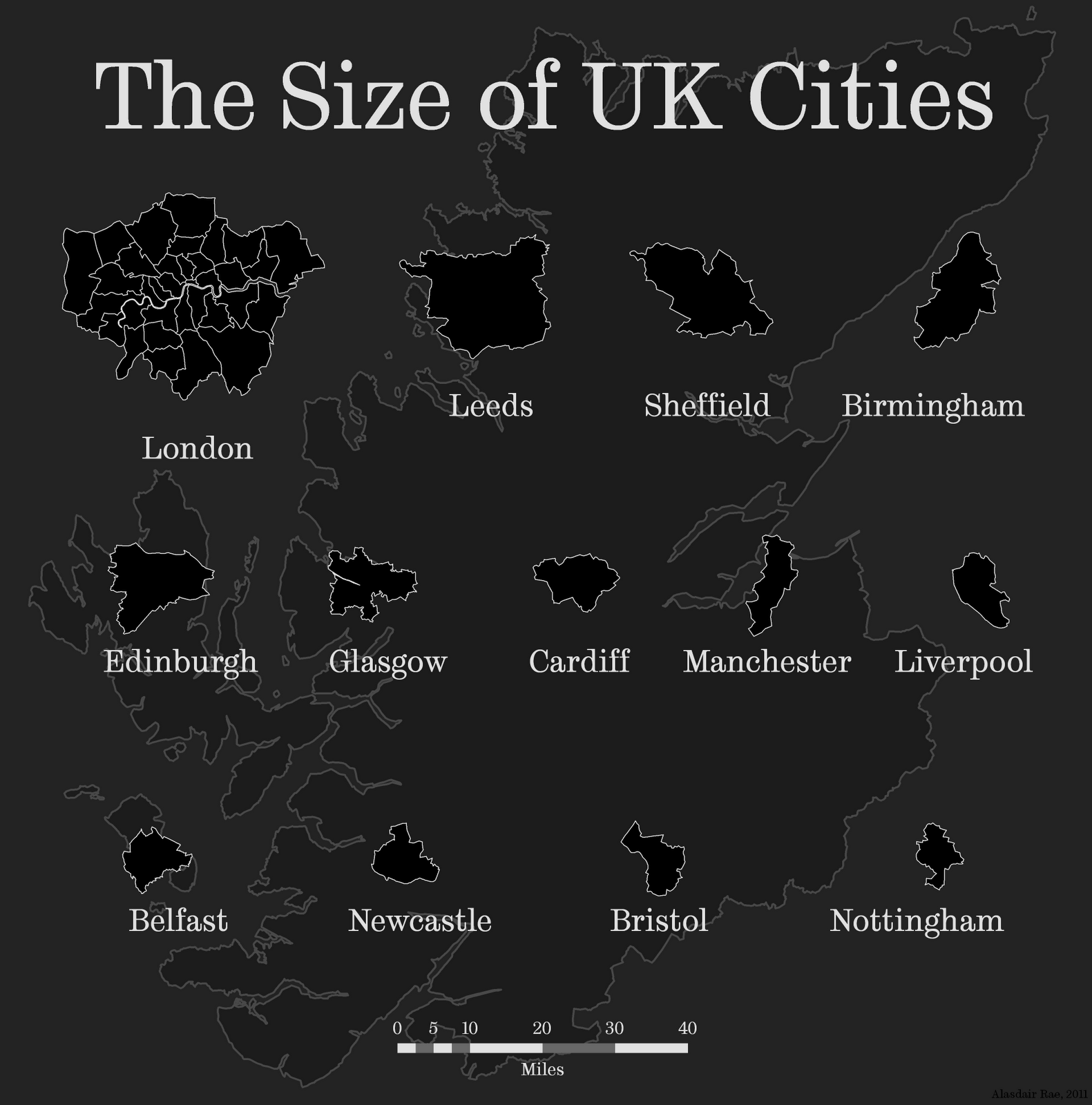
In studies of cities and urban areas, a common question that crops up is 'how big' a particular city is. I'd be inclined to answer this in terms of population, which for Greater London in mid-2010 was 7.83million. Most urban academics, however, are more pedantic and if you asked them how big London is, they might ask what you mean by 'big' and what you mean by 'London'. So, following the theme of some posts over the past year I decided to take a look at this purely in terms of the land area of some key UK 'cities'. I looked at the London Boroughs for Greater London, plus local authority areas for the English core cities, plus Edinburgh, Glasgow, Cardiff and Belfast. I then put them side by side at the same map scale and produced the following image...


The cities (i.e. the local authorities) in the image above are ranked by land area. London is the largest, at around 610 square miles, and Nottingham is the smallest at around 30 square miles. One issue when thinking about all of this is the extent to which most of the UK's cities are 'underbounded' in the sense that the core local authority area with the name of the city does not reflect the true extent of the functional urban area. Manchester is a classic example of this, whereas Leeds is more 'overbounded'. Tony Champion and Mike Coombes, among others, have written about this - e.g. in this presentation. In many ways this is quite a serious policy challenge, particularly when it comes to understanding and planning for wider metropolitan housing and labour market processes. But I'm getting carried away with myself now!

Finally, I thought it would be interesting to compare the areas in the image above to the UK's largest local authority by area. I did this because a) I'm from the Highland region and b) see reason a). The Highland region is, famously, about the size of Belgium and it is bigger than both Wales and Northern Ireland by some way. In relation to the latter, it is more than twice the size in terms of land area. However, in mid-2010 the total population of the Highland region was only 221,630. A final nugget of information: the Highland region is about 275 times larger than Liverpool. The image below shows the Highland region at the same scale as the areas in the first image. Perhaps we should all move up north and have more space! Or perhaps not.


P.S. The City of London is the smallest administrative 'district' in the UK, at around 1.1 square miles. 

Friday, 2 September 2011

Divided Cities?

There has been a lot of talk recently about the links between deprivation and the recent riots in England (e.g. this from the Guardian), and since I'm interested in the issue I thought I would do some very basic analysis to look at the spatial divisions of deprivation in English cities. To do this I took London, the eight core cities plus Bradford, Coventry, Hull and Leicester and mapped the 10% most (in red) and 10% least (in blue) deprived (IMD 2010) areas on one large map graphic. The results are shown below - click the image to enlarge.


Some interesting comparisons can be made from this image. In Hull, Leicester, Manchester and Nottingham there are no areas amongst England's 10% most deprived and in Liverpool there is only one. In Sheffield there is a clear NE/SW split in terms of the location of the most and least deprived and in Manchester, Birmingham and Liverpool the number of areas in the most deprived 10% is quite high.

Not much else to say now except that I think in studies of deprivation we should perhaps be more concerned with inequalities and how they manifest themselves spatially.

Thursday, 11 August 2011

Comparing Deprivation in the English Core Cities

The eight English core cities outside London often work together on issues that affect them. One thing I've been looking at recently on some work in Sheffield is how the core cities compare in terms of patterns of deprivation. So, I've mapped and compared them below. Red areas are amongst the 10% most deprived in England and the darkest blue areas are amongst the 10% least deprived in England. The maps are at different scales but the point here is just to provide a quick visual comparison of cities in this map matrix view.


Friday, 8 October 2010

Travel to Work Areas / Labour Market Areas

I've been doing some work recently which uses travel to work areas rather than local authority boundaries. The analysis is on deprivation in England using the Economic Deprivation Index, so I thought it would make more sense to do the work within the context of more local labour market areas. In England, the best proxy for these is the travel to work area or TTWA.

There are currently 243 of them defined in the UK - and there is a lot more information on this (including the methodology) available here. One part of what I have been doing is to compare the size of TTWAs for different places.

In the maps below you can see the London, Birmingham, Liverpool and Manchester TTWAs displayed at the same geographical scale. The TTWA areas are coloured and the local authority boundaries are overlaid on top of this with black lines. Click on the image below to see it full size in your web browser.

It may be a bit of a surprise to see how big some of the non-London TTWAs are. Clearly, London is the largest and includes the most local authorities but Manchester and Birmingham in particular cover large areas and Liverpool covers a large north to south area.