Showing posts with label edinburgh. Show all posts

Friday, 4 April 2014

Some thoughts on mapping spatial patterns of deprivation

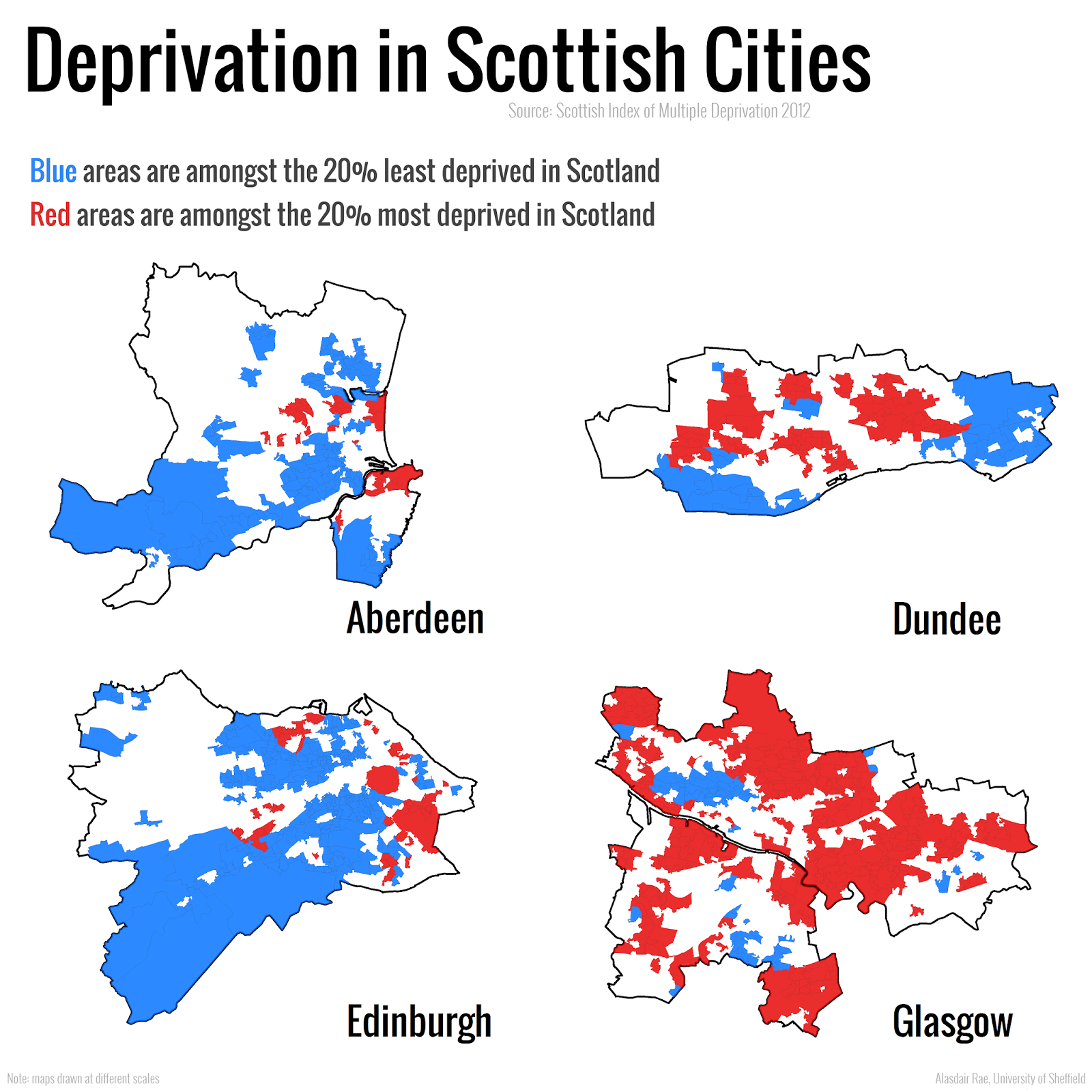
In my research into the geography of deprivation across the UK, I frequently use maps to illustrate the spatial patterns associated with the areas identified as 'least' or 'most' deprived according to official indices such as the Scottish Index of Multiple Deprivation or the English Indices of Deprivation. Lots of other people do similar kinds of things, including mapping gurus such as Oliver O'Brien from UCL (his work is much nicer). A recent example is shown below, which I also tweeted this week. It's difficult to know exactly how people will interpret such maps, particularly when they are only seeing them on twitter without much in the way of context being provided, so this short blog fills some of the gaps and discusses some wider issues.

In previous academic papers (e.g. Urban Studies, 2009; Regional Studies, 2012; Local Economy, 2012) I've written about deprivation quite a bit, and on the need for the debate to centre not just on 'deprived' areas but more widely upon the wider dynamic of socio-spatial inequality. It's a shame that the focus is still very much on 'poor' or 'deprived' areas so in an attempt to draw attention to the urban inequalities which exist across the UK I attempt to illustrate the socio-spatial disparities within different cities. I also did this in a report on Sheffield from 2011 where I tried to draw attention to the socio-spatial inequalities within English cities, as shown below. It's not that concentrated deprivation isn't a problem (far from it) but rather that it's part of something much bigger.


These kinds of maps do draw attention to the general issue but of course they can lead to all sorts of other conclusions and claims because as we know, maps are an abstraction from reality and they do not represent an absolute 'truth'. These maps simply colour small areas within cities according to how they are classified by a government metric which attempts to say how 'deprived' places are. This may be a dubious practice in many respects, but it is woven into the fabric of how places are understood in a policy context and how problems are defined. It's important that we understand what this kind of mapping allows us to say and what it does not. Some of this is covered on the 'What does it all mean' tab of my Scottish Index of Multiple Deprivation 2012 map site, but I want to make a few more points here...

1. Colours. They are not intended to match up to any political party but some people inevitably make such inferences. The maps say nothing about the causes of the patterns, or who is responsible for them. But it doesn't stop people from talking about it and that's no bad thing. There is a lot more that could be said about colour choice but I'm going to leave it there for now.

2. The trouble with choropleth maps. Maps shaded according to some value (such as deprivation rank) present a misleading picture in a number of ways but two important ones stand out here: a) not all people in the area are 'deprived' or 'non-deprived'. This is the classic 'ecological fallacy' issue at work - the third paragraph here says more about that; and b) the shaded zoned themselves cover much wider areas than people actually live in so a big blue or red area gives the impression of a lot of something, when in fact the population of larger spatial units is similar to the smaller ones (as it often is with LSOAs or Data Zones in the examples above). 

3. The sometimes arbitrary nature of local authority boundaries. Places like Leeds are often said to be 'overbounded', whereas Manchester is 'underbounded'. This means that the local authority boundary either extends beyond the core urban area or it doesn't include much of it at all. So, in the cases of Manchester and Liverpool above if you were to extend the boundary of the map you would see more areas that are not so deprived. However, the point here is that local authorities have to deal with the financial, social and spatial implications of these patterns. What happens beyond the boundary is not part of their remit - even if it does impact upon them. The boundaries may be arbitrary in some respects but they have very real implications.

4. Why not take a different approach? A good idea, and one that Oliver O'Brien in particular has been very successful with. If we only look at where people actually live then we get a more realistic (but still not 100% accurate) picture of the spatial patterns associated with deprivation. This can be done using dasymetric mapping, where we assign the attributes of areas to individual features. This isn't a perfect definition, and the technique itself can lead people to assume a higher level of accuracy than can actually be obtained from the underlying data but it has advantages over standard choropleth maps in relation to depicting the places where people actually live or work. See also Neal Hudson's London tenure map in this style. The new OS Open Data VectorMap District buildings layer for Great Britain allows us to do this, so I've produced an example map for Glasgow based on the one in the first image above. This time you can only see the areas where there are buildings (though many are not residential properties).


Is the map above more 'truthful' than the normal choropleth? Probably not. However, this is all irrelevant if we aren't concentrating on the underlying patterns we're trying to draw attention to in the first place. The point is that in cities like Liverpool, Manchester and Glasgow the high levels of deprivation/poverty/disadvantage sit in stark contrast to areas at the other end of the scale. Also, places that we think of as 'deprived' are often far from it - as Peter Matthews might also argue. It's this kind of inequality which I'm attempting to highlight with my mapping - though I do of course like a nice looking map (I've also produced more than a few stinkers in my time). The point of all this? I hope that these maps can start a conversation about the underlying issue. I'll end with an extract from my 2012 Regional Studies paper on the issue...


Tuesday, 18 December 2012

SIMD2012 - An Interactive Website

With the release of the latest version of the Scottish Index of Multiple Deprivation I thought I would take the time to put together an interactive mapping website so that people who are interested in exploring spatial patterns of deprivation could easily interact with the data. The official Scottish Government interactive mapping site has some nice features but I find it a bit cumbersome and the map interface is too small for my liking so that's why I've produced my own version, based on Google Fusion Tables.


Putting this together has prompted me to develop some additional mapping tools using Fusion Tables code and these can be accessed via the 'Tools' tab on the new website. The 'search and zoom' allows you to enter a place you want to look for and when you hit 'Search' the map immediately pans and zooms to that location.   The other tool I've created simply lets you turn the SIMD map layer on and off, which is quite a useful feature.

I've just looked at the relative ranks of places within Scotland in this site. For details of absolute change you can see the employment and income domain data available from the new SIMD 2012 website.

Thursday, 19 July 2012

The Petermann Iceberg

There's a big story in the news today about an iceberg that has broken away from the Petermann Glacier in Greenland. These things are always compared to real places in order to provide context and this case is no different. The BBC reported that the iceberg is 'twice the size of Manhattan'. This is big, but exactly how big is it? It's roughly 100 square miles. That's the same size as Edinburgh. But how big is that? To answer these questions I've just modified an earlier image based on the size of UK cities (local authority boundaries) to put it in context. Put simply, this iceberg is bigger than Bristol, it's bigger than Cardiff, it's bigger than Manchester. It's just big. Click the image below to see for yourself.


Thursday, 13 October 2011

How Big is London?

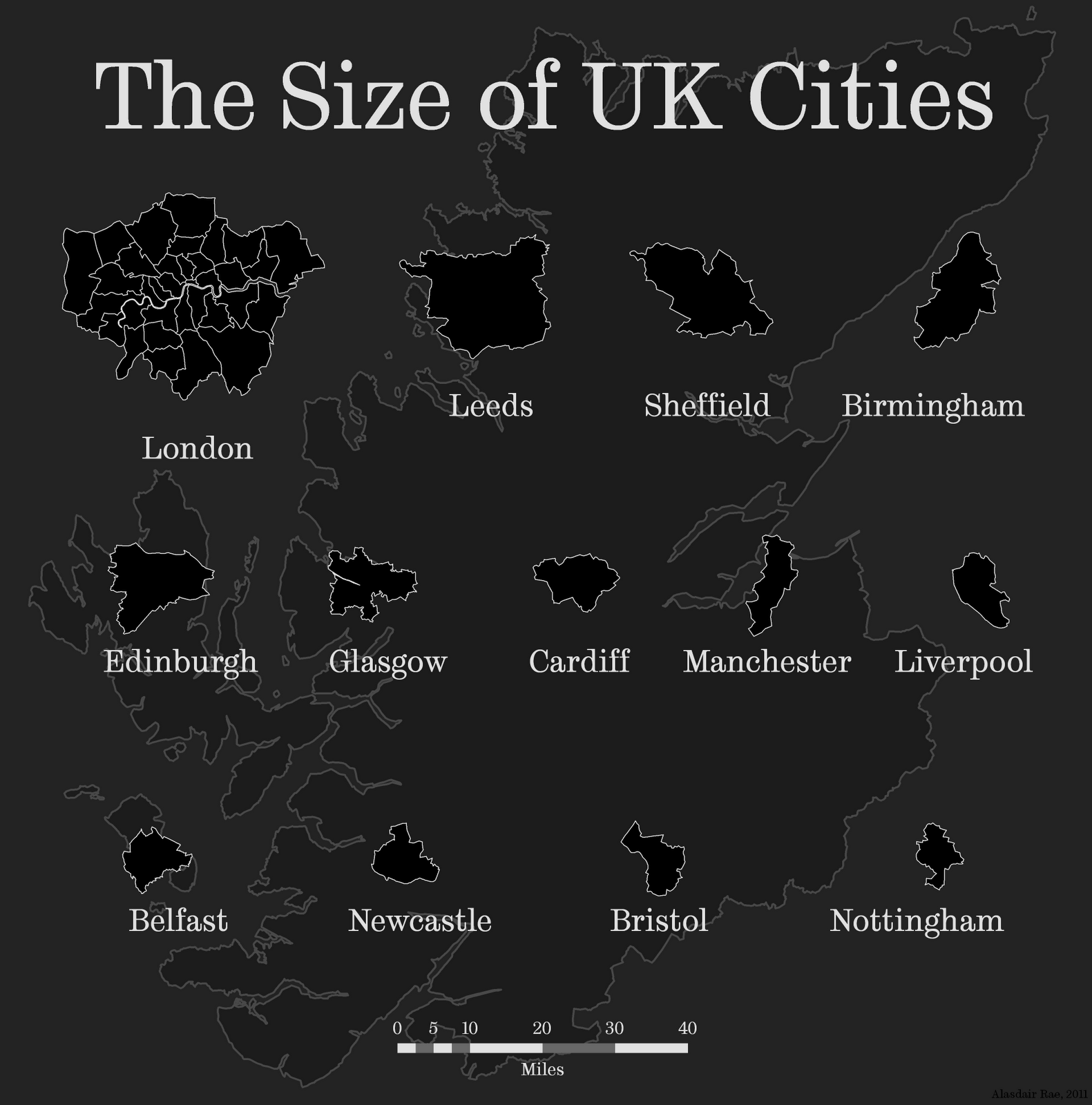
In studies of cities and urban areas, a common question that crops up is 'how big' a particular city is. I'd be inclined to answer this in terms of population, which for Greater London in mid-2010 was 7.83million. Most urban academics, however, are more pedantic and if you asked them how big London is, they might ask what you mean by 'big' and what you mean by 'London'. So, following the theme of some posts over the past year I decided to take a look at this purely in terms of the land area of some key UK 'cities'. I looked at the London Boroughs for Greater London, plus local authority areas for the English core cities, plus Edinburgh, Glasgow, Cardiff and Belfast. I then put them side by side at the same map scale and produced the following image...


The cities (i.e. the local authorities) in the image above are ranked by land area. London is the largest, at around 610 square miles, and Nottingham is the smallest at around 30 square miles. One issue when thinking about all of this is the extent to which most of the UK's cities are 'underbounded' in the sense that the core local authority area with the name of the city does not reflect the true extent of the functional urban area. Manchester is a classic example of this, whereas Leeds is more 'overbounded'. Tony Champion and Mike Coombes, among others, have written about this - e.g. in this presentation. In many ways this is quite a serious policy challenge, particularly when it comes to understanding and planning for wider metropolitan housing and labour market processes. But I'm getting carried away with myself now!

Finally, I thought it would be interesting to compare the areas in the image above to the UK's largest local authority by area. I did this because a) I'm from the Highland region and b) see reason a). The Highland region is, famously, about the size of Belgium and it is bigger than both Wales and Northern Ireland by some way. In relation to the latter, it is more than twice the size in terms of land area. However, in mid-2010 the total population of the Highland region was only 221,630. A final nugget of information: the Highland region is about 275 times larger than Liverpool. The image below shows the Highland region at the same scale as the areas in the first image. Perhaps we should all move up north and have more space! Or perhaps not.


P.S. The City of London is the smallest administrative 'district' in the UK, at around 1.1 square miles. 

Tuesday, 2 August 2011

Joblessness in Edinburgh and Glasgow


I'm currently finishing off a piece of work relating to spatial patterns of labour market deprivation in Scotland so I thought I'd share a couple of findings about the contrasting cities of Edinburgh and Glasgow*. I've been using data from the Scottish Index of Multiple Deprivation (2009) employment deprivation domain, which gives a jobless rate for each small area (Data Zone). The official explanation is that it is 'involuntary exclusion from the labour force' and it includes things like unemployment claimants and incapacity benefit claimants.

I've been looking at the data within the context of local labour markets and have done some comparisons between Edinburgh and Glasgow. The data are now a bit old (from 2008) but what's really interesting are the numbers... In Glasgow, the total population of Data Zones where the jobless rate was 25% or more was a little over 170,000 (more than the population of Dundee) and areas with a rate of 33% or more contained just over 51,000 people (more than the population of Perth). By contrast, the figures for Edinburgh were just under 25,000 and just under 11,000 respectively. Even when you take into account the difference in population (about 600,000 for Glasgow vs. 450,000 for Edinburgh) that's a big difference! I know this contrast isn't particularly surprising but the numbers did surprise me a bit.


*I've added Aberdeen and Dundee because David Manley suggested it. A good idea!