Showing posts with label manchester. Show all posts

Monday, 14 September 2015

The Shapes of Cities

For a long time, I've been interested in the shape of cities and I suspect that if you're reading this you might be similarly afflicted. By 'shape' I mean their political boundaries as opposed to their general urban footprint. The latter can be seen by driving around or from a plane window, particularly when it's dark, but the political boundaries are much less obvious. This is particularly true of US cities. Take Houston, Texas - the first example below. 
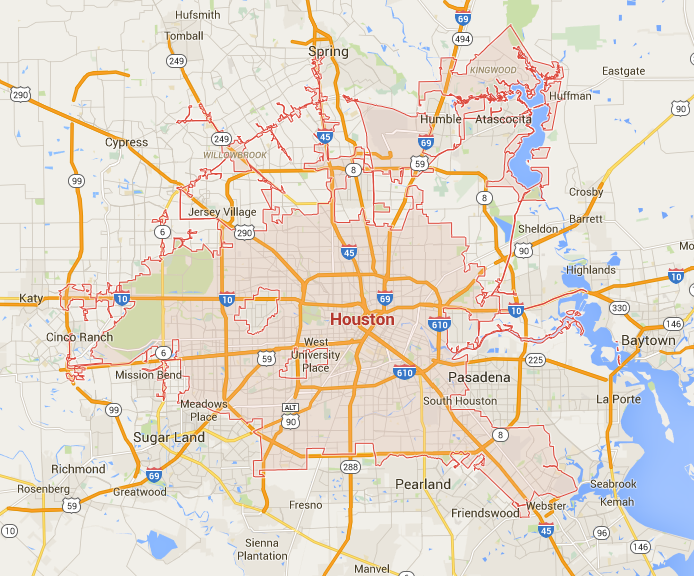
The boundary of the City of Houston - Google Map

Look closely at this and - at least if you're not used to the political geography of American cities - you might be very confused by this fragmented, segmented mess of boundaries. Then go to Google maps and try different search terms, such as 'city of los angeles' or 'city of columbus' (Ohio) and you'll soon discover that Houston isn't that unusual at all. Try it for other cities and you'll see what I mean. Columbus, Ohio is a particular favourite of mine as I know it quite well having lived there for a couple of years in the early 2000s.

City of Los Angeles - Google Map

City of Columbus (Ohio) - Google Map

These unnatural-looking boundaries are the result of a complex mix of geography, history and politics that have real impacts on the ground. From education and transport to housing and waste management, the shapes of cities really do matter in this respect. Of course, this is a much-studied topic in urban studies, not least by Professor John Parr of the University of Glasgow. In Parr's economic definitions of the city, he outlines four types - but none of these explain the kinds of boundaries we see above. One major explanatory factor in all of this, of course, is tax revenue. But I'm not going to get into that now because it opens up a whole range of other topics, including white flight, suburbanisation, and schooling, amongst other things. The point is that the 'shapes' of cities are not accidental and who is included or excluded is inherently political. 

In the United Kingdom, we might not have such unusual city boundaries, but the political geography of our cities is far from perfect - perhaps one reason for the resurgence of the 'city-region' concept over the past decade or so. When we're talking about urban economies, it makes much more sense to think about the functional urban area than it does to use data associated with an arbitrary political shape. This is as true in the US as it is in the UK. The example below shows that the City of Atlanta has less people than the City of Liverpool and that it's only slightly bigger in scale. But anyone who knows anything about these places will understand that 'Atlanta' is much bigger than 'Liverpool and is vastly more sprawling, with a metropolitan population of around 5.5 million compared to less than a million in 'Liverpool' (by one definition). 

Atlanta vs Liverpool - which is bigger?

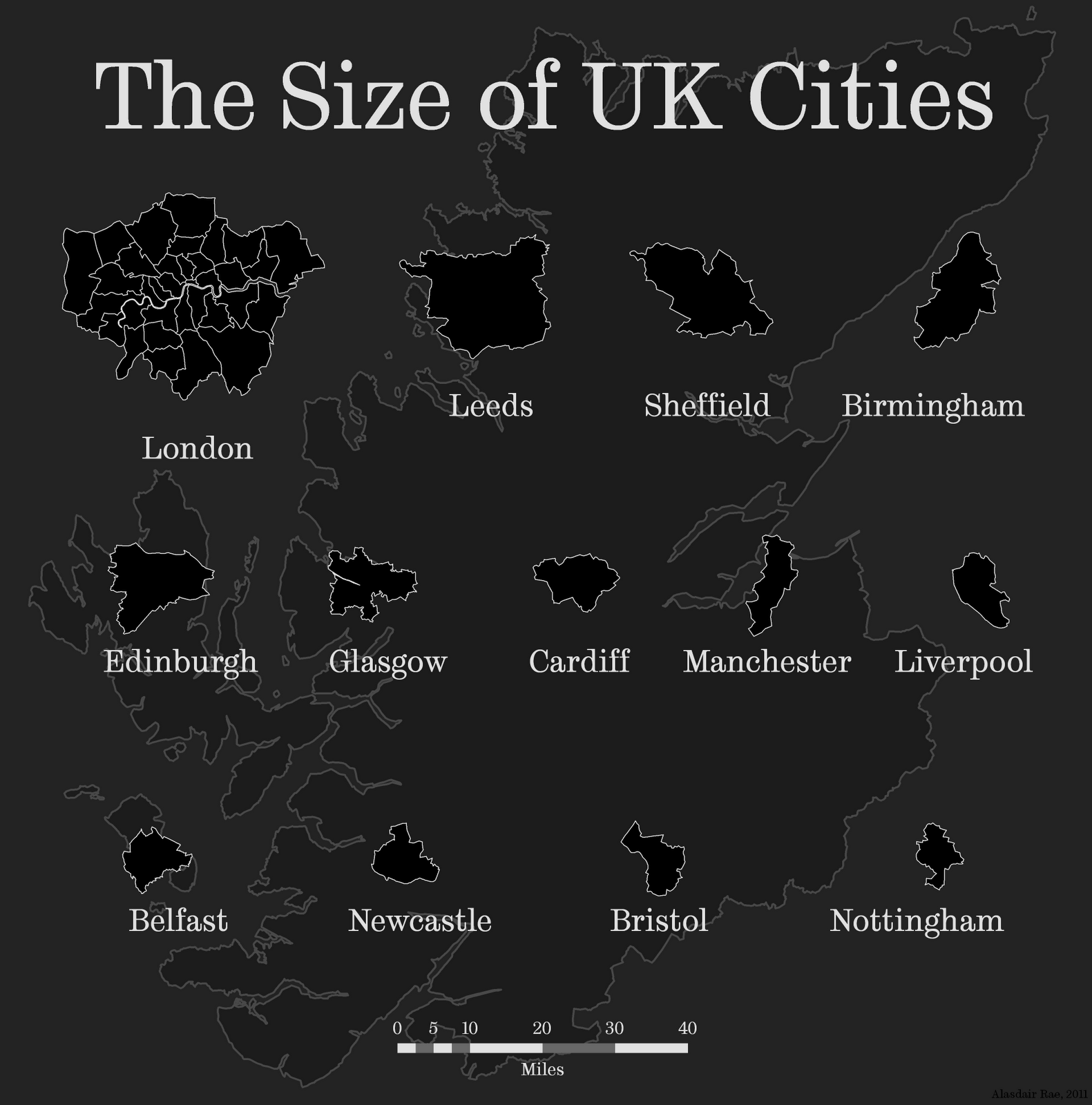
These kinds of issues are part of the reason organisations like the Centre for Cities use the Primary Urban Area definition of cities for the 64 largest urban areas of the UK. In a recent study, I used a definition developed by Geolytix which is based on the 'sprawl' of the urban area rather than political boundary and found this to be a much better fit than the administrative area. When conducting comparative analyses of cities, we need to ensure we are comparing like with like, and using a functional definition often helps avoid the kinds of underbounded/overbounded problems that arise when (e.g.) comparing places like Manchester and Leeds. The former is normally said to be 'underbounded' because the functional urban area is much bigger than the local authority area of the same name and the latter is said to be 'overbounded' because of its much wider local authority area, which extends beyond the core urban fabric. For a comparison of UK 'city' sizes, see this graphic I produced a few years ago:

All cities shown at the same scale
Surely there's a point to all of this? 

Yes, glad you asked...

For planners, politicians, residents and neighbours, the shapes of cities matter enormously. It might dictate which school your children can go to, whether your local facilities are well funded, whether you have a well-functioning local transport system, when your bins get emptied, how many pot-holes you have in your street and all sorts of other things. But let's not get into that now. Instead, I'll end with another city shape, this time for the City of Detroit (one of my favourite cities, but much-maligned).

Detroit - 8 mile boundary line to the north


Wednesday, 14 January 2015

Visualising Residential Mobility in Urban England

Last year I produced a few commuting maps of England and Wales after the 2011 Census data were released. Now I've turned my attention to mapping patterns of residential mobility in urban areas of England as part of my work on understanding housing markets. This post highlights some of the patterns uncovered in the data - which are output area level migration flows for England and Wales (about 4 million individual flows). If you're interested in how I did this you can find out in a previous post. The first image is of the urban North West of England and for subsequent images I've zoomed to different parts of the country. I've kept it simple and only showed the flow lines, apart from in the North West where I've also added some place labels. It's all a bit experimental at this stage.

You can find a higher resolution image here


The North East of England


West, East and South Yorkshire


I think some places are missing (working on it)


I've adjusted the brightness a little to make this clearer

What does all this show? It shows what many people may already know or expect but basically it illustrates the extent of residential mobility patterns in some of England's major urban areas - plus a bit more in the South West example above. There's a lot more that could be said about this but for now I'll leave it at that. I'm sorry if your town or city isn't on the map! Maybe next time...


Notes: I've filtered the data so in certain cases some places are not shown (e.g. in the North West image places in North Wales are not visible). Also, I've only shown flows of a certain volume in order to filter out the noise. 

Tuesday, 4 November 2014

Manchester: a "Northern Powerhouse"

The announcement yesterday from the Chancellor that we need a "Northern Powerhouse" in England was greeted with much enthusiasm - and also a good bit of cynicism, given that it's not far from the General Election. After the announcement, the BBC asked whether more English cities should be like Manchester. What I wanted to know was how this nascent northern powerhouse compared to the already established southern one (London, I think). We all know the numbers - well most do - but what about spatial scale, density and visual comparisons? Given a previous bit of mapping on the urban fabric of England and the fact that I've been thinking about the 'underbounded' nature of the City of Manchester (as opposed to the city region), I thought I'd go a bit further with this post.

The first image here shows how Greater London compares to Greater Manchester - they're mapped at the same scale - and I've also put the Greater Manchester boundary over Greater Manchester and vice versa, just to show that they're not that radically different in size.

Greater Manchester - a large urban area (higher res version)

I've also produced the same image without the respective boundaries overlaid on each city, just to provide a quick visual comparison at the same scale.

Click for higher resolution image

Finally, in order to demonstrate the way in which the City of Manchester is really 'underbounded' in relation to its wider city region, I've shown just the urban fabric of the City of Manchester (i.e. building footprints) in relation to the ten local authority areas of Greater Manchester, beside Greater Manchester as a whole. 

Click for bigger version

I have some even higher resolution images if anyone is interested - if so, feel free to get in touch via e-mail or twitter (@undertheraedar). I just wanted to produce these images to illustrate the fact that Greater Manchester is actually very big (about 80% of the size of Greater London in area) though of course has far fewer people (about 33% of the population). It does seem like the most likely 'northern powerhouse' in England and it will be very interesting to see how things pan out over the coming years.


Monday, 26 November 2012

Population growth in Manchester city centre, 2001 to 2011

Manchester city centre experienced a population explosion between 2001 and 2011. In the area covered by the map below the population increased by nearly 400% - from 5,957 to 23,295; a rise of 17,388 people.  In 1991, the same area (roughly) had a population of 2,887, as you can see here. Anyone who knows Manchester will know about this but possibly not about the scale of the change. A lot has been written about these changes (e.g. Centre for Cities in 2006, Manchester Evening News in 2012) but it is clear that much of the growth experienced in Manchester has been driven by a new phase of city centre living. Click an area on the map to find out more about it and zoom in to the larger version of the Google map to see it in more detail.


But who are these new residents? Chris Allen, writing in 2006, said they might be a mix of 'counter-culturalists' from the new middle class, 'city centre tourists' from the service class and 'successful agers', who tend to be over 50. Whoever they are, they're living in the new apartment buildings that began to sprout in the perforated urban landscape of central Manchester over a decade ago.

The map above contains a total of 15 small areas known as super output areas. If you click on any area you can find out how many people now live in each. The map also tells you the total land area of each small parcel and how many households are in it. You can find more of this kind of information via the Guardian datablog and also by clicking through to the raw data on the ONS web pages. It was only released on Friday but I've been looking at it now because I'm writing a short paper on small area population change in the English core cities. Central Manchester has grown the most but other cities have also experienced rapid expansions.

A note for spatial analysts: the 15 LSOAs you see in the map above are new. They are just 15 of the 229 new LSOAs across the core cities and this makes change over time analysis a little more tricky. Manchester's total population growth during this period was just under 20% (or 80,000) so the growth in the centre accounted for just over 21% of the increase.

Friday, 16 December 2011

Deprivation in Sheffield

This summer I was asked to write a report about deprivation in Sheffield. I finished this in September and the reaction since then has been quite positive (i.e. people have actually been reading it!). So, I thought I'd link to it directly here and also pull out a few of the main findings from it. Click on the image below to see the pdf - or just click here.


In the report I look at how patterns of deprivation in Sheffield compare to 13 other cities in England. Sheffield is not as deprived as many other cities (e.g. Liverpool, Manchester) but the geography of deprivation in the city means that it is one of the most divided - spatially at least. In one sense this might have something to do with the boundaries of local authorities and how wide an area they cover but, ultimately, it is at the local government level that issues associated with deprivation are most acutely felt so the boundary issue is only part of the problem.

I also look at the differences between areas that seem to be similar in terms of how deprived they are. In doing so I draw upon some previous work I did with colleagues at the University of Manchester. The bottom line here is that there there is a need to think more deeply about the different roles and contexts of areas and how they differ from each other - particularly in relation to how policies are formulated.

There is also a need to think about issue of social and spatial inequality more widely rather than simply focusing on the 'most deprived' locations, though of course this will remain a policy priority in many cities. 

Thursday, 13 October 2011

How Big is London?

In studies of cities and urban areas, a common question that crops up is 'how big' a particular city is. I'd be inclined to answer this in terms of population, which for Greater London in mid-2010 was 7.83million. Most urban academics, however, are more pedantic and if you asked them how big London is, they might ask what you mean by 'big' and what you mean by 'London'. So, following the theme of some posts over the past year I decided to take a look at this purely in terms of the land area of some key UK 'cities'. I looked at the London Boroughs for Greater London, plus local authority areas for the English core cities, plus Edinburgh, Glasgow, Cardiff and Belfast. I then put them side by side at the same map scale and produced the following image...


The cities (i.e. the local authorities) in the image above are ranked by land area. London is the largest, at around 610 square miles, and Nottingham is the smallest at around 30 square miles. One issue when thinking about all of this is the extent to which most of the UK's cities are 'underbounded' in the sense that the core local authority area with the name of the city does not reflect the true extent of the functional urban area. Manchester is a classic example of this, whereas Leeds is more 'overbounded'. Tony Champion and Mike Coombes, among others, have written about this - e.g. in this presentation. In many ways this is quite a serious policy challenge, particularly when it comes to understanding and planning for wider metropolitan housing and labour market processes. But I'm getting carried away with myself now!

Finally, I thought it would be interesting to compare the areas in the image above to the UK's largest local authority by area. I did this because a) I'm from the Highland region and b) see reason a). The Highland region is, famously, about the size of Belgium and it is bigger than both Wales and Northern Ireland by some way. In relation to the latter, it is more than twice the size in terms of land area. However, in mid-2010 the total population of the Highland region was only 221,630. A final nugget of information: the Highland region is about 275 times larger than Liverpool. The image below shows the Highland region at the same scale as the areas in the first image. Perhaps we should all move up north and have more space! Or perhaps not.


P.S. The City of London is the smallest administrative 'district' in the UK, at around 1.1 square miles. 

Monday, 3 October 2011

Comparing Populations: Night Time vs. Day Time

Esteemed Canadian and fellow researcher Brian Webb, from the University of Manchester, recently sent me an interesting image which compares the population of Washington D.C. in the day to the population at night. This got me thinking. I did a bit of digging and found some of my old data. Put simply, I had two datasets for wards in the North West of England. One file contained the resident population of wards and the other had the population of wards during the day time (i.e. residents, minus out-commuters, plus in commuters). Out of this came two visualisations, as shown below (red peaks = more people) and a short video.


I also decided to turn this into a very simple animation, which is embedded below. I have also produced a larger version of this on its own page. Note: the video embedded below will keep playing once you click play. The larger version allows you to pause the video and watch at your own pace.

Unable to display content. Adobe Flash is required.

Although these are really just some pretty pictures there are some important points to be made here. We think about the population of places - and the associated local costs and constraints - in relation to resident population but in some areas the day time population is so high that the impact on the local area is far out of proportion to the size of the resident population. Another matter is the well known issue of spatial mismatch or, more generally, understanding the differences between where people live and where people work and the implications of this. 

In short, understanding the spatiality of populations is important for planning and policy purposes - these visuals are just a simple way of telling the story of data. This is important because the data on display here comes from an analysis of a commuting data matrix of 1000 x 1000, or one million cells of data. So, another point here is that data on its own is not information, as we all know.

Friday, 2 September 2011

Divided Cities?

There has been a lot of talk recently about the links between deprivation and the recent riots in England (e.g. this from the Guardian), and since I'm interested in the issue I thought I would do some very basic analysis to look at the spatial divisions of deprivation in English cities. To do this I took London, the eight core cities plus Bradford, Coventry, Hull and Leicester and mapped the 10% most (in red) and 10% least (in blue) deprived (IMD 2010) areas on one large map graphic. The results are shown below - click the image to enlarge.


Some interesting comparisons can be made from this image. In Hull, Leicester, Manchester and Nottingham there are no areas amongst England's 10% most deprived and in Liverpool there is only one. In Sheffield there is a clear NE/SW split in terms of the location of the most and least deprived and in Manchester, Birmingham and Liverpool the number of areas in the most deprived 10% is quite high.

Not much else to say now except that I think in studies of deprivation we should perhaps be more concerned with inequalities and how they manifest themselves spatially.

Thursday, 11 August 2011

Comparing Deprivation in the English Core Cities

The eight English core cities outside London often work together on issues that affect them. One thing I've been looking at recently on some work in Sheffield is how the core cities compare in terms of patterns of deprivation. So, I've mapped and compared them below. Red areas are amongst the 10% most deprived in England and the darkest blue areas are amongst the 10% least deprived in England. The maps are at different scales but the point here is just to provide a quick visual comparison of cities in this map matrix view.


Thursday, 24 March 2011

Indices of Deprivation 2010

The English Indices of Deprivation 2010 were published this morning. Previous Indices were published in 2000, 2004 and 2007. I've decided to do a few posts on this because I find it very interesting and it does have real implications in relation to policy. In this post, I've done some basic mapping and analysis (click on any map to view it full size).

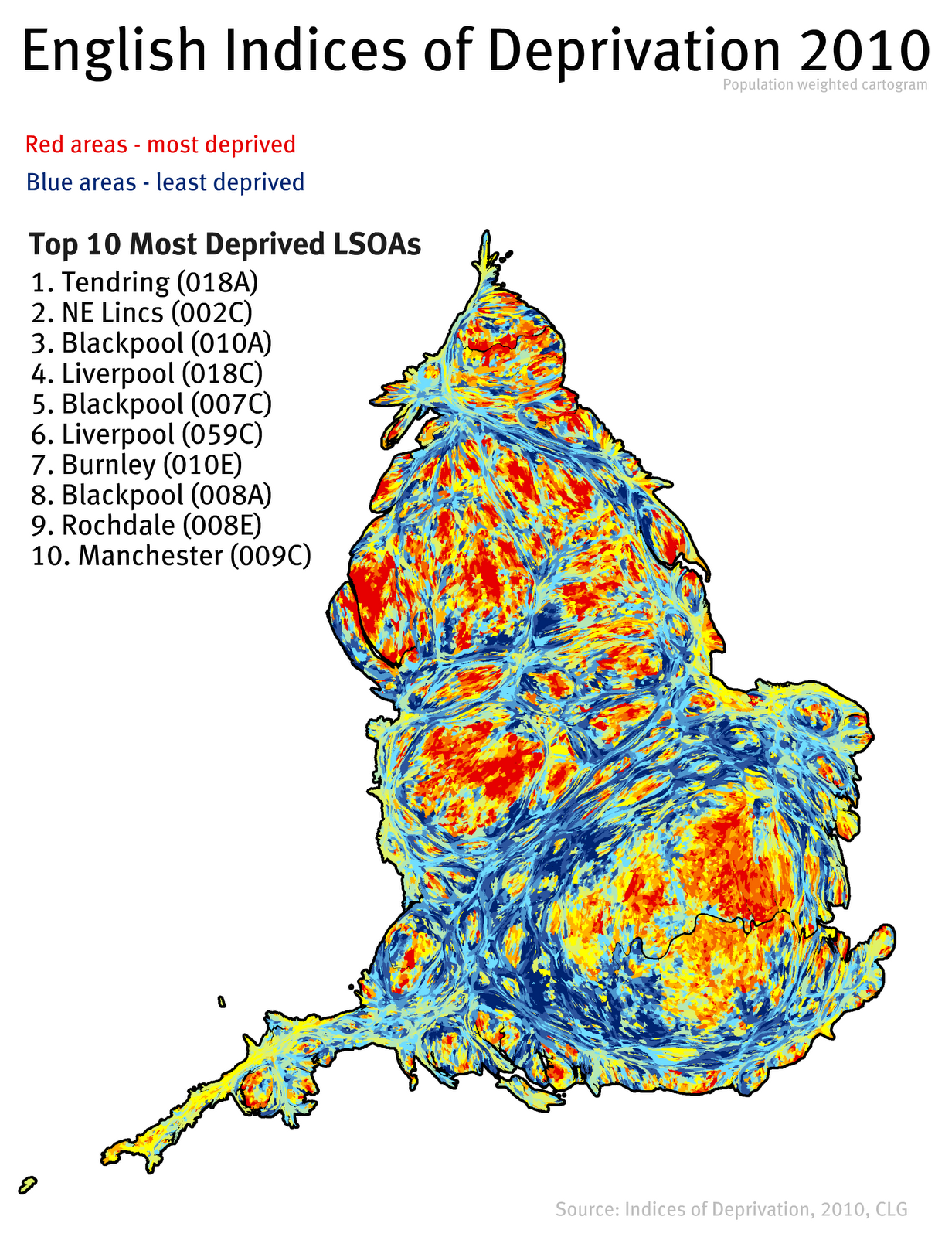
A quick snapshot first: the most deprived LSOA is in Tendring, Essex. It used to be in Liverpool. Overall, Liverpool, Middlesbrough, Manchester, Knowsley, Hull, Hackney and Tower Hamlets remain the most deprived local authorities. So, no major surprises.

Overview for the whole of England, with a list of top ten most deprived LSOAs.


Overview cartogram for England, with a list of top ten most deprived LSOAs.


Detailed map showing location of the most deprived LSOA in England.


A zoomable google map version of the above, for good measure.


View Tendring 018A in a larger map

A more focused map of Merseyside, showing Liverpool, Sefton and Knowsley.


Note: The Indices of Deprivation 2010 are produced for small areas called LSOAs. These lower layer super output areas are not 'neighbourhoods' in a formal sense but they often have a high degree of internal similarity. The average population of an LSOA is about 1500 and in total there are 32,482 of them in England. The data used in the Indices are mostly from 2008 but you can read more about this in the technical report.

Friday, 8 October 2010

Travel to Work Areas / Labour Market Areas

I've been doing some work recently which uses travel to work areas rather than local authority boundaries. The analysis is on deprivation in England using the Economic Deprivation Index, so I thought it would make more sense to do the work within the context of more local labour market areas. In England, the best proxy for these is the travel to work area or TTWA.

There are currently 243 of them defined in the UK - and there is a lot more information on this (including the methodology) available here. One part of what I have been doing is to compare the size of TTWAs for different places.

In the maps below you can see the London, Birmingham, Liverpool and Manchester TTWAs displayed at the same geographical scale. The TTWA areas are coloured and the local authority boundaries are overlaid on top of this with black lines. Click on the image below to see it full size in your web browser.

It may be a bit of a surprise to see how big some of the non-London TTWAs are. Clearly, London is the largest and includes the most local authorities but Manchester and Birmingham in particular cover large areas and Liverpool covers a large north to south area.

Sunday, 11 April 2010

Manchester Commuter Inflows

A short post today on visualizing commuting flows. I've used some 3D GIS techniques to create a commuting surface for the North West of England (based on wards). Areas with peaks represent high in-commuting. Manchester dominates the North West pattern, as seen below.

I added in flow lines to this map in order to see which 'peaks' were being by-passed on the way to Manchester, and from where. The lines on the map below represent flows of 25 or more from individual wards in the North West. Not a huge number per ward, but it all adds up. When you think of how many people are doing this and how far they come it is significant however...

This is only really a rough draft, but it does communicate quite a bit of information and it tells a familiar story of urban commuting. Click on the map to see it in full size.

Saturday, 9 May 2009

Sustainable Communities in Manchester

A new piece of work has recently been published by the Manchester Independent Economic Review (MIER), a Commission set up to provide an evidence-base for decision making in the Manchester city region (MCR). The publication is called 'Sustainable Communities' and is an overview of deprivation and neighbourhoods in MCR. Some of the material is related to work I was involved in during my time at the Centre for Urban Policy Studies in Manchester and I still have an interest in what's going on there. Changes in neighbourhoods in many parts of MCR have been good, but the performance varies across the different areas.

Since I'm doing some work on indicators and spatial policy monitoring at the moment, I thought I'd do a short post on this topic. In particular, I wanted to explore the changes in the percent of people in each Greater Manchester district (Bolton, Bury, Oldham, etc...) who live in areas ranked among the 10% most deprived nationally between the Indices of Deprivation from 2004 and 2007. In actual fact, of course, the IMD2004 is based mainly on data from 2001 and the IMD2007 on data from 2005 - so the comparison here is really between conditions in 2001 and 2005. Nonetheless, I wanted to see how things had changed.

I linked the population in each lower layer super output area (LSOA) to the IMD data for each area and then added up the population in each district that fell within the most deprived 10% nationally (i.e. ranked from 1 to 3,248). The results are provided in the chart below, followed by some comments. [Quick explanation: for example, Trafford now has around 2% less of it's population living in areas classified as amongst the 10% most deprived in England - this ought to mean things are getting better - very crudely speaking]


As you can see, the population of Manchester within the 10% most deprived nationally (England) has fallen by around 8%. This is the most obvious change. Falls were also evident in Bury, Salford, Trafford and Wigan. In contrast, Bolton, Oldham, Rochdale, Stockport and Tameside (marginal) saw a rise in the population ranked amongst the 10% most deprived nationally.

Notwithstanding such issues as the ecological fallacy and questions about the validity of such indices in the first place - the changes are very interesting - particularly when we begin to ask questions about how these changes have occurred. Has it been because of household mobility, increased prosperity, or another reason? That's for someone else to answer. For now, I'll just finish by adding this chart on population changes between 2001 and 2005 - it makes an interesting comparison (has the increase in Manchester's population between 2001 and 2005 been a process of displacement of less well off people by more affluent people? maybe).

Sunday, 12 April 2009

The Economic Deprivation Index (EDI)

I've been meaning to blog on this for a while, so here goes...

Relatively recently, the Department for Communities and Local Government released the Economic Deprivation Index for the purposes of 'tracking neighbourhoods' through time in relation to their levels of economic deprivation. They did this because the existing Indices of Multiple Deprivation (2004 and 2007) 'do not facilitate backwards comparison nor do they enable users to understand how the pattern of deprivation is changing between these fixed points' (CLG, 2009).

Despite this, several examples of comparison between 2004 and 2007 deprivation levels have been produced at the local level - e.g. exhibit a, exhibit b - though I'm not picking on anyone here; I actually think there is a good deal of confusion that needs to be addressed since the new EDI says what is quoted above and the information on the 2007 Indices of Deprivation page says 'comparison between the two Indices is therefore acceptable'. So, it is hardly surprising that people compare IMD 2004 and 2007.

Anyway, back to the topic at hand. The EDI is comprised of data from the Income and Employment Domains of the IMD and is produced on a yearly basis from 1999 to 2005. The maps below summarise changes at LSOA level, where green is an improvement in rank and red is a reduction in rank. You can click on the images for larger maps.

More commentary follows below... but the official report is worth a look.

England EDI Change in Rank 1999-2005 (Green = Improvement, Red = Decline)


A couple of nuggets here for England as a whole... The largest change in rank towards being more deprived was 17,769 - for a LSOA in Slough (008D), which changed from a rank of 31,509 in 1999 to 13,740 in 2005. Since LSOAs are quite small, and the data very sensitive to micro-spatial factors, such changes are not entirely surprising (but I do wonder what happened here). In total, 27 LSOAs saw their rank change by 10,000 or more places towards being more deprived and the majority of these were in the south of England.

At the other end of the scale, there were 22 LSOAs which changed rank by 10,000 or more towards being less deprived. The LSOA experiencing the largest improvement was in Tower Hamlets (029A) with a rank change of 18,463 places. In 1999 it was ranked as the 12,878th most deprived in England (so, not really that deprived) and by 2005 it had moved to 31,341. More interestingly, one LSOA in Nottingham (026C) was amongst the most deprived in 1999 (ranked 3,150) but by 2005 was ranked 16,873 (a change of 13,723 places - the fourth largest improvement). The big leap forward came between 2002 and 2003 (new build 'luxury apartments'?).

London EDI Change in Rank 1999-2005 (Green = Improvement, Red = Decline)


We can also take a closer look at London - there does seem to be a more obvious pattern of change between 1999 and 2005 than for England as a whole. This is clearer towards inner London and perhaps reflects even more severe housing market pressures in the capital - particularly in Westminster, Islington, Tower Hamlets and Hackney. The outer boroughs, and Hillingdon in particular, seem to have become more deprived according to the EDI - although this is all relative of course because some of these areas are not at all 'deprived'.

Manchester EDI Change in Rank 1999-2005 (Green = Improvement, Red = Decline)


And now to Manchester, because it is the location of the LSOA that has remained most deprived on the EDI for each year from 1999 to 2005 (Manchester 009C). The overall pattern looks not too bad, with mostly greens. However, when you overlay the location of the 10% most deprived LSOAs (2004 IMD - since these are the main policy targets), things don't necessarily look so good. Lots of areas which remain the focus of policy have not improved on the EDI - they have become worse according to this measure. The exact change in rank may not be statistically significant but it is notable that they have not been able to improve rank at all. I'll not go into whether or not such indices are a useful measure - that's not for me to decide. I just thought it would be useful to explore the data for now.

So, that's the Economic Deprivation Index... Now I need a holiday.

Friday, 20 March 2009

Spoke too Soon

Further to my last post about Google Maps street view, where I said that it wasn't available in the UK - just this week it has become available, to much hype and hysteria. Twenty five cities in all, including where I live now (Sheffield), where I used to work (Manchester), where I used to live (Liverpool) and where I went to university as an undergraduate (Glasgow). I've hunted around for people I know, but no luck yet... For now, just some images of places I know - note that you can navigate these within the blog!

Housing Market Renewal Area in Liverpool

View Larger Map

Raining in Manchester? Surely Not...

View Larger Map

Tenements in Glasgow

View Larger Map

Thursday, 4 September 2008

The New vs. the Old - Flow Mapping

Back again to a familiar topic - flow mapping. In the past all we had was paper and two dimensions. Now we have e-everything and things can easily be displayed in three dimensions (or 2.5D as we say in the GIS world). The reason for this post is that I'm currently revising some maps for a journal and I have come to the conclusion that some things just can't be effectively displayed in a static, old fashioned manner - they must be made interactive to work properly.

The map below shows about as much as it is possible to show in a traditional geovisualisation of migration. Here I have shown all moves into Manchester (the local authority) between 2000 and 2001, with reciprical links (i.e. where people have moved both in and out along the flow line path) in red, with unique inflows in yellow. I'm busy with other things now, and am still working a lot on the e-learning and screencasting side of things, so time to go...

Wednesday, 28 May 2008

How Many People Live in Manchester?

A quick post on a common urban theme. Answering the question of how many people live in a city is very tricky. Do you use the political boundaries of the local authority? Do you use the extent of the urban area? Do you use some other definition? In a completely unscientific experiment, I've developed a different approach - and it turns out that the populations I come up with are not that different to those given for the city-regions of the places on my list.

Here's what I did...
I took the eight core cities in England, plus London and chose the main central train stations in each of them as the central location (e.g. Lime Street in Liverpool). Then I used a bit of GIS wizardry to calculate the population within a 15 mile radius of said stations (statistically significant distance determined after much spatial analysis... and a bit off the top of my head). Here's the results (using ancient 2001 Census data):

Obviously, these figures differ a lot from the local political entities with the same names (e.g. Manchester the district has about 430,000 people). Even though I've used a fairly arbitrary technique, the populations are a much better reflection of the urban population than others often cite. So, let's compare the figures. On Census day in 2001 London had 7,172,091 people, Birmingham city-region had 2,693, 917, Manchester city-region had 2,482,328 and the other cities on the list show similarities to the 15 mile figure. What does this tell us? Not much really, except that if we use a 15 mile buffer from central train stations we get a good approximation of city-region populations for the major English cities. Here's how it looked on the map: